Abused children score as ADHD
In a Harvard study of severely abused children, around three in ten met the full ADHD criteria. Not some of the items. All of them.
Section 1 · sources listed in the bookA book by Paul Stewart
Doubt the label. Ask the child.
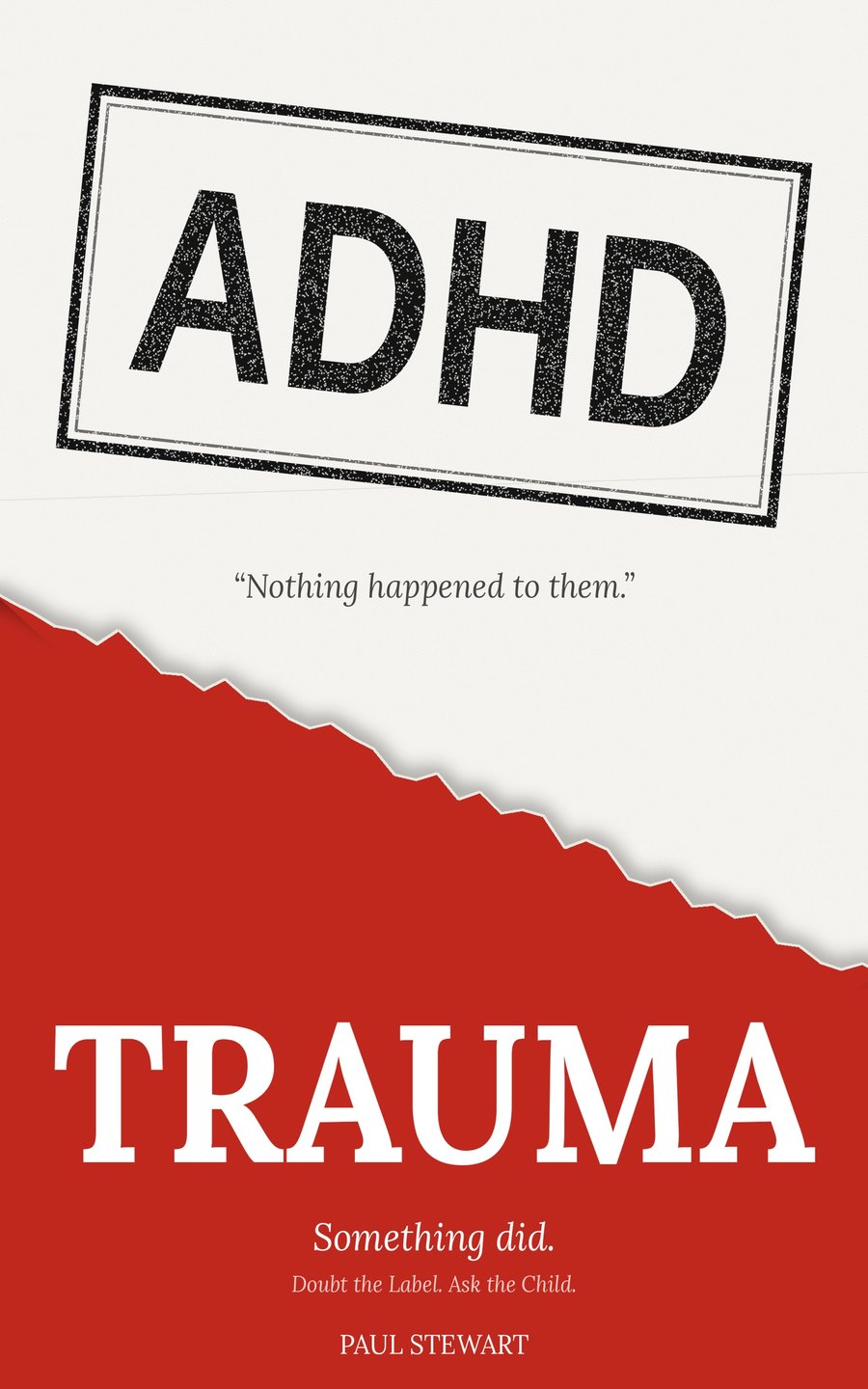
One in nine children now carries the label. The test for it is eighteen behaviours, ticked by adults on a form. There is no blood test and no scan. Nothing on the form asks what has happened to the child.
Every item on that checklist is also what a child looks like after something bad has happened. So a hurt child and a child born restless come out identical — and the form is the whole test.
This is the test. Read it twice — once each way.
What a child with ADHD looks like
Ticked by a parent or a teacher. Six of nine in either half, for six months, and the child has it.
Nothing in the list moved.
Only the heading did. That is the problem the book is about: there is no item on this form, and no step in the pathway behind it, that can tell the two children apart. One question can. It is the one nobody asks.
Not opinion. The field’s own evidence, with the reference under every claim so you can go and check it yourself.
In a Harvard study of severely abused children, around three in ten met the full ADHD criteria. Not some of the items. All of them.
Section 1 · sources listed in the bookIn 1978, researchers gave the ADHD drug to ordinary schoolboys with nothing wrong with them. They went calm and focused too. So “the medication works” proves the drug is a stimulant. It proves nothing about the child.
Rapoport et al., 1978, Science · doi.org/10.1126/science.341313Healthy children were put to bed an hour later for a week. Their teachers, who did not know which week was which, rated them as more restless, more impulsive, more distracted. Nobody’s brain changed. Their bedtime did.
Gruber et al., 2012, Pediatrics · doi.org/10.1542/peds.2012-0564Children taken out of Romanian institutions and raised in good homes still had brains 8.6% smaller as adults — and the longer they had been left there, the smaller. That reduction tracked their ADHD symptoms.
Mackes et al., 2020, PNAS · doi.org/10.1073/pnas.1911264116This is not an argument against medication, and it is not a reason to stop anything. Some children are restless from the first day, nothing happened to them, and the tablets help. Never change a child’s prescription without the prescriber.
The argument is narrower and harder: there is no test that separates that child from the one who has not slept in a year because of what happens in his house — and the pathway never asks.
I was diagnosed with ADHD at six, four months after something happened to me that nobody asked about. I am not a doctor and I have no degree. I have followed this field for most of my life, without a stake in it, reading the studies the pathway relies on and the ones it leaves out.
I wrote this to put one question in front of every adult who fills in a form about a child: what happened to them?
— Paul Stewart
The book is for sale. The Action Kit is not — it is free to download, copy, print and hand to anyone who needs it, and always will be.
This page is the address printed in the back of the book. I read everything that arrives here.